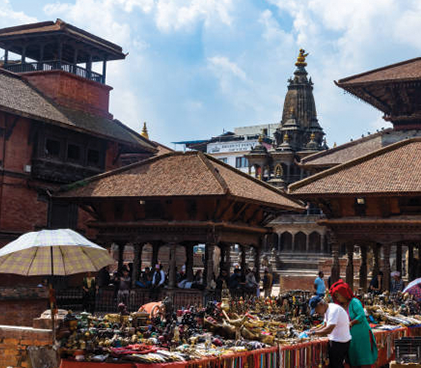
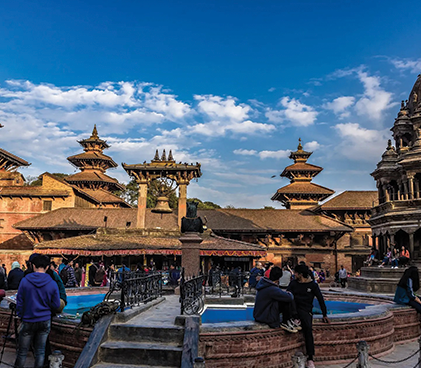
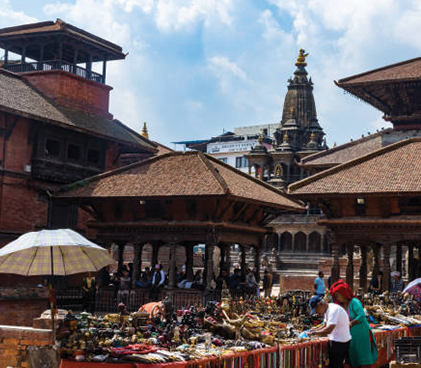
Patan Durbar Square monument zone, the heart of Patan city, is one of the seven monument zones of Kathmandu Valley World Heritage Site, enlisted by UNESCO in 1979. The major attractions in this area include the 17th century palace complex and several other temples and shrines noted for their exquisite carving. This monument zone is also an excellent example of a medieval town with winding streets opening up into lively urban square with unique architectural character that is still distinctly in evidence. One of the finest examples in this square is the 17th century Krishna temple, the first Shikhar style structure in Nepal with 21 spires and constructed entirely of stone with carvings depicting the Hindu epic Mahabharat.
Although much of the 17th century urban patterns and the public structures still exist in commendable state, Patan Monument Zone is losing much of its vernacular architecture that is mostly under private ownership. The significance of this unique architectural heritage which includes the associated minor architecture, such as the traditional private houses has not been fully appreciated by its residents. Patan has been a vital city for almost two thousand years and this long history has brought in many changes in its architectural style along with the political changes as well as the influence of the outside world. Historically, these changes were slow and adaptive to the vernacular styles, materials and technology. However, in recent years these changes have been quite drastic with the introduction of foreign materials and technology. The change and expectations of the changing contemporary lifestyles has also had devastating effects on the traditional fabric of this historic city. The beautiful old buildings, the fine examples of the rich Newari architecture, are vanishing day by day and being replaced by unsympathetic concrete structures.
Lack of knowledge of the value of historical houses is also hampering in the conservation of this historic city. The cost of restoration is perceived to be higher than that of demolishing and replacing them by new concrete houses and the homeowners are not given any financial incentives to restore their buildings. Rules and regulations are not strong enough and their implementation is very ineffectual.
Anticipating the consequences of the loss of this invaluable resource, Patan Tourism Development Organization (PTDO) initiated a programme in 1997 to identify and promote selected traditional houses within Patan Monument Zone and renovate these properties providing new sympathetic uses for them. The Urban Development through Local Efforts project (UDLE / GTZ) extended its help in preparing existing and proposed plans of the three identified buildings and also prepared the cost estimation. PTDO with the active support from the Department of Archaeology of His Majesty’s Government (HMG) of Nepal and UNESCO experts proposed these projects to UNESCO for international funding. This proposal was also produced in the donors’ meeting held in Kathmandu in 1996 that was jointly organised by UNESCO World Heritage Centre & HMG Department of Archaeology and chaired by Right Honourable Mr. Sher Bahadur Deuba, the Prime Minister of Nepal. In 1998 National Federation of UNESCO Associations in Japan (NFUAJ) showed interest in this project and agreed to fund two projects, namely the Shrestha House and the Rajbhandari House.
1. THE SHRESTHA HOUSE:- The Shrestha House is a well–preserved example of a traditional Newari house of Kathmandu valley. The house is located on the road between the Durbar Square and the bridge across the Bagmati at Sankhamul Ghat, which is an ideal location for its intended new use. The property is built of brick and timber in traditional Malla style with three wings around a courtyard, the narrowest wing of which had been well restored and converted to modern living.
2. THE RAJBHANDARI HOUSE:- The Rajbhandari House, which faces onto one of the smaller squares in the Patan Monument Zone, is an outstanding example of traditional town house of the Malla period. The front and side wings embrace a large internal courtyard, which is partially closed on its fourth side by a separate building from the Shah period. Behind this structure lies an attractive garden.
The principal objective of this programme is to create awareness among the residents the significance of their rich architectural heritage and simultaneously encourage them to conserve their buildings by providing financial incentives through this effort and converting these houses into quality tourist accommodations. This programme would expand the limited number of tourist accommodations in Patan while conserving the town, the invaluable source for tourism in the city. This project was mainly aimed to achieve the following goals:
To encourage the owners of traditional buildings in Patan to upgrade their houses and help in conserving traditional architecture thus increasing the value of old buildings.
To make the traditional house income generating in order to maintain the building as well as provide financial support to the owner.
To increase tourist accommodation facilities in Patan and extend their length of stay.
To promote tourism industry in Patan in an internationally competitive environment.
Since PTDO is a non for profit organization dedicated to the promotion of tourism in Patan, it was decided that the grant received from NFUAJ would be used as seed money for a Revolving Fund that would offer loans to the homeowners at a nominal interest rate so that this fund would be used to fund more similar ventures. PTDO would assist in the management and promotion of these restored houses and the loans could be paid back once the tourist accommodation started operating in order to encourage the homeowners to restore and operate the business themselves. This would not only give financial assistance to the homeowners and increase the number of tourist accommodations in Patan but would also provide wonderful opportunities for the foreign visitors to experience traditional living in an authentic setting.
The programme kicked off in mid 1999 with the restoration and conversion of the Shrestha House upon the receipt of funding from UNESCO. The initial target for completion was October 31, 2001, however, due to various reasons, this project, unfortunately, could not be completed in stipulated period of time. The second of the two approved projects, the Rajbhandari House also got delayed for various reasons and finally started in May 2004. The Rajbhandaris have shown their commitment to complete the project contributing an additional 7.5 percent of the total budget for this work. Both these buildings will be in operation in the near future.