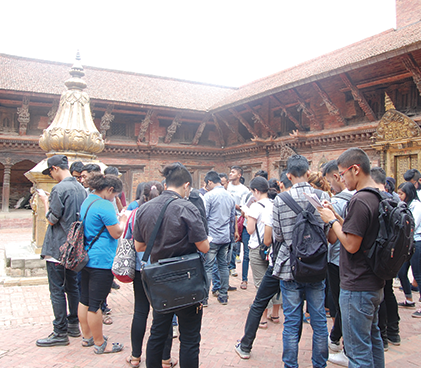
Following the Alternative Tour guidebook, another attractive book, the Patan Walkabout was also published with detailed descriptions of the route covering almost fifty percent of the tour included in the Alternative Tour. This book was published with financial contributions from Lalitpur Sub-Metropolitan City and UDLE, edited by Mr. Kanak Mani Dixit and written by Mr. Bijay Lal Shrestha. The proceeds from the sale of this book are earmarked for the conservation of cultural heritage and promotion of this city, which will give continuity to the various conservation activities in Patan. This book is gaining popularity with foreign visitors as well as locals, especially after making it to the popular Lonely Planet Guide Book.
For the visitor to Patan, the tour begins where the bus stops at Patan Dhoka, the arched north gateway to the old city. Past the whitewashed gate, you enter a plaza lined with cafes, grocery stores and newspaper stalls. Beyond lie the still mostly medieval neighbourhoods of Patan. On the far side of the square, you will see a canopied chaitya or stupa (the terms are interchangeable, although stupas are generally larger) with images of Buddha on each of its four sides. Patan has stupas and chaityas in abundance, in various shapes, sizes and antiquity. Just part the chaitya in front of you is a well which is still in use by the residents of the neighborhood. The lane you have entered is actually the central thoroughfare of Patan, and it will take you directly to Darbar Square-the end of the Walkabout-in about 20 minutes of leisurely walking. However, you will be taking a more roundabout route to get there.
Just past the chaitya and well, at a fork in the lane, you will come upon a double-roofed temple of Ganesh. The elephant-headed deity is found at street-level and the entry is flanked by two stone lions standing guard. This is an appropriate point to begin your Patan Walkabout, for Ganesh is the deity invoked when a new venture is begun or upon setting out on a journey. Turn your back to the temple and take the brick-paved lane at which the stone gaze of the lions is directed. Within a minute you will arrive at a small Hindu shrine placed within a cemented structure. Nest to it is a Buddhist chaitya together with a mandala (a diagrammatic representation of the universe) at table-top level. Further along, where you see a pati (a covered rest platform), the lane opens up into Sulima Square.
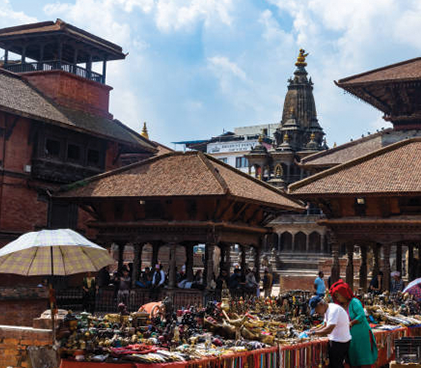
The holy water of River Bagmati has played an important role in the development of Patan as a City of Art and Culture. According to Hindu water cosmology, life begins and ends with water. Believers of this philosophy worship the river as the Universal Mother Goddess Ganga.
For this reason, residents of Patan and beyond come to Shankhamul Ghat along this sacred River Bagmati to take their last breath. Shankhamul ghat is also believed to be the ultimate gateway to heaven, from where even the sinful souls find their path to Narayan, the Supreme Lord of the Water World.This Shankhamul Cultural Walk begins from the mighty Bhimsen Temple near the Ayu Guthi Sattal in Patan Durbar Square and takes you through numerous fascinating alleys carrying a history of more than 2000 years of riverine civilization to the sacred ghats and brings you through winding stone-paved streets back to the House of Long Life.
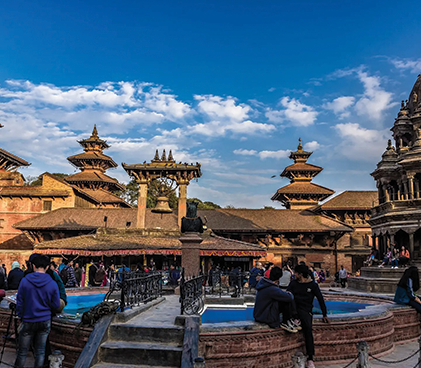
During the Lalitpur Festival in 1998, the concept of an inner city tour for visitors was started by the Lalitpur Sub-Metropolitan City to showcase its achievements and development works in the city. This tour was also intended to highlight and promote the rich cultural and architectural heritage of Patan. This tour later became known as the Alternative Tour of Patan that took a visitor through the narrow lanes and inner courtyards providing an insider’s view of life and activities of the local communities.
Realizing that the success of this novel tour depended on its proper interpretation, about 250 tourist guides have been trained with the Hotel Management and Tourist Training Centre and the Tourist Guide Association. Urban Development through Local Efforts (UDLE), a GTZ project, extended its support for the publication of this tour map.